
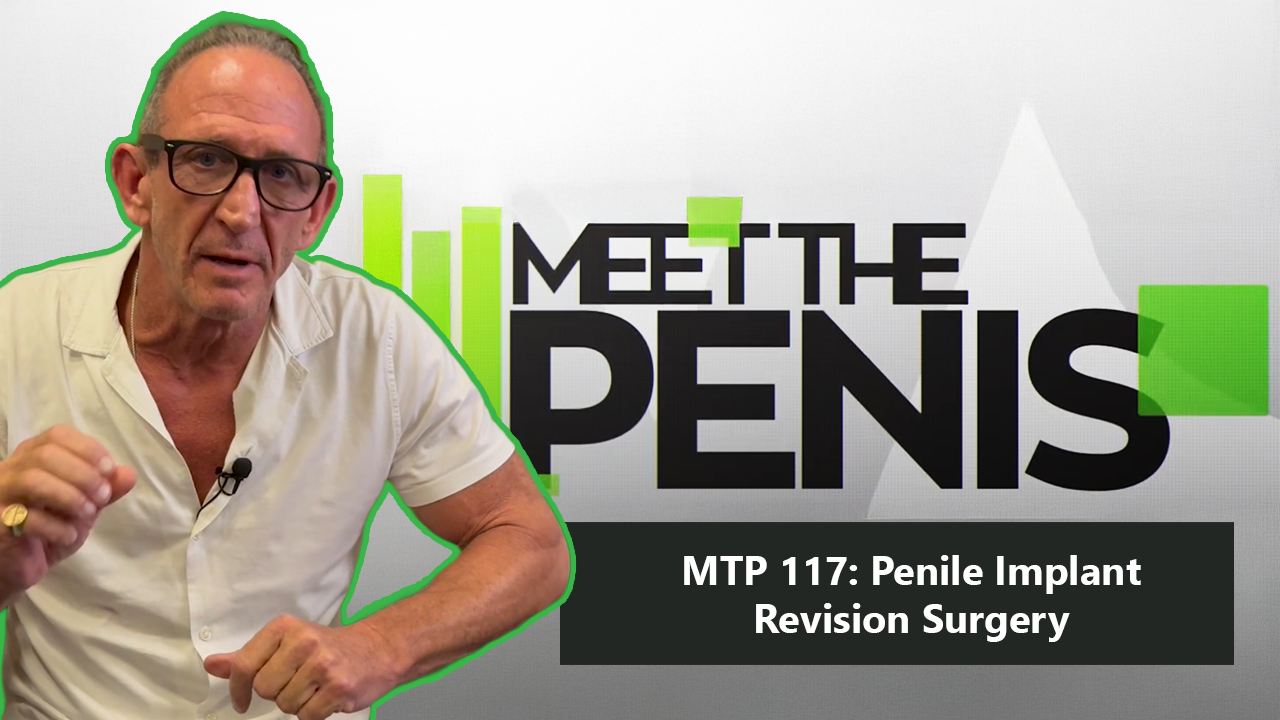
Penile implant surgery remains one of the most reliable procedures in all of medicine with the highest level of patient satisfaction. But, as Dr. Paul Perito emphasizes in Meet the Penis #117, there’s an important side of this conversation that doesn’t get enough attention: revision surgery.
Revision surgery is not the starting point, but rather what happens when something doesn’t go according to plan. While outcomes can still be excellent, it is a more complex, higher-stakes procedure that both patients and surgeons must approach with respect.
What Is Penile Implant Revision Surgery?
A penile implant revision means returning to the operating room to:
- Replace a malfunctioning device
- Correct positioning issues
- Address complications such as infection, erosion, or cylinder problems
As Dr. Perito puts it:
“I don’t like revision surgery… it means something didn’t go right, whether it’s the implant, the surgeon, or the situation.”
Why Penile Implant Revision Surgery Carries Higher Risk
One of the most important teaching points from this episode, which is supported in medical literature is that infection risk increases with each revision.
Primary, or “virgin” implant infection rates are between one and two percent when performed by a high-volume implant clinic like Perito Urology. In revisions, the risk of infection is significantly higher.
The increased risk of infection is due to a number of reasons; scar tissue reduces blood flow and immune response, bacterial biofilm can develop from previous surgeries, and repeated surgical procedures can inhibit healing capacity.
This shows why it’s important to get a penile implant procedure right the first time: A virgin implant is like placing something into fresh, healthy soil. A revision is like reworking ground that’s already been disturbed: harder, less forgiving, and more prone to complications.
Not All penile implant Revision Surgery Is the Same
There’s a spectrum to penile implant revision surgery that’s important for patients to keep in mind. Less complicated procedures are typically due to mechanical failure (e.g. pump or cylinder malfunction). More complicated procedures are typically due to infection, erosion or extrusion of the implant, or large amounts of scar tissue.
The more complex the case, the more important surgeon experience and surgical judgment become.
Why Recovery is Slower Than a First-Time Penile Implant
A primary “virgin” penile implant usually takes two to three weeks of recovery before being fully functional. A revised implant takes significantly longer to activate (four to six weeks) and sometimes longer for the healing process.
Dr. Perito highlights a critical warning:
“If you rush back into sexual activity too early after a revision, you risk damaging the implant—cylinders can herniate or shift.”
For patients, it demands more patience to heal correctly with a revision.
The Role of Surgical Technique and Experience
Despite the increased risk, outcomes can still be excellent in expert hands.
High-volume implanters who follow meticulous sterile protocols, use up-to-date techniques (antibiotic coatings, no-touch approaches, careful handling), and properly select and counsel patients can keep complication rates closer to baseline, even in revisions.
This reinforces a key principle:
Who performs your revision surgery matters as much—if not more—than the surgery itself.