
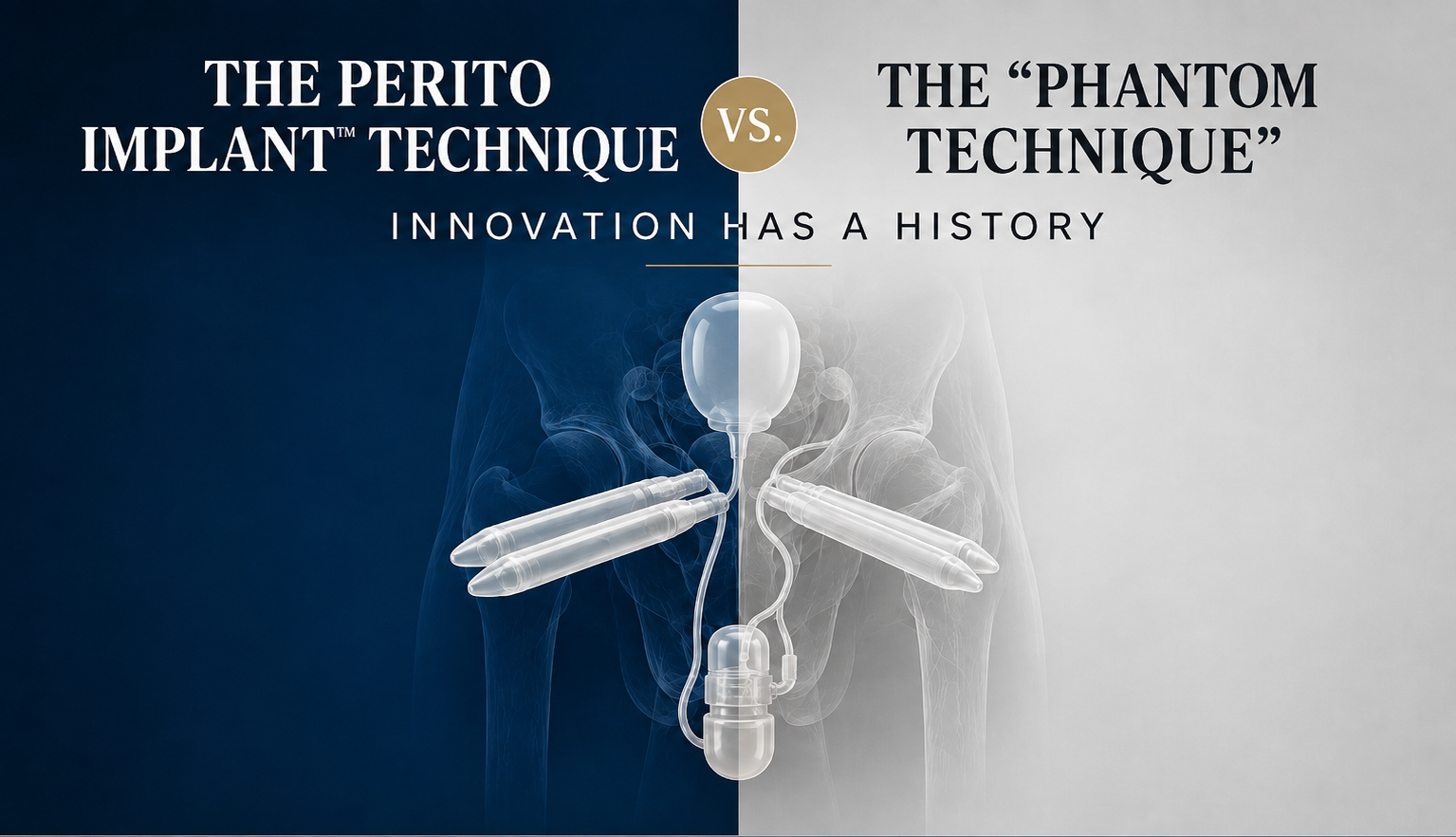
A New Name Does Not Necessarily Mean a New Operation
In surgical medicine, innovation should ideally be defined by what is new. This could be a new operative approach, a meaningful technical modification, better outcomes, or evidence supporting a different method.
That distinction matters when discussing the so-called “Phantom Technique,” also called the “Ghost Technique,” for penile implant surgery.
The Phantom Technique is promoted as a penile implant procedure performed through a small incision above the base of the penis rather than through the scrotum. But that anatomical route is already well-established; it’s the infrapubic approach to penile prosthesis implantation.
Implant manufacturer Rigicon describes the Phantom Technique as a patient-friendly name for the infrapubic approach, rather than a separate surgical operation.
Dr. Paul Perito published his standardized minimally invasive infrapubic penile implant technique in The Journal of Sexual Medicine in 2008, nearly two decades before the Phantom terminology appeared in patient-facing marketing.
That history is documented in the medical literature and in the development of the Perito Implant™ Technique.
Is the Phantom Technique Different From the Perito Technique?
To most patients and laypersons, the procedures are very similar: Both use an infrapubic incision above the base of the penis rather than a primary penoscrotal incision. Through that operative field, the surgeon places the cylinders within the corpora cavernosa, positions the reservoir, and places the pump within the scrotum.
The meaningful question, therefore, is not where the incision is made. It is whether the Phantom Technique introduces distinct operative maneuvers that materially differentiate it from previously published infrapubic techniques.
What Makes the Perito Implant™ Technique a Defined Surgical Technique?
The Perito Implant™ Technique is more than the location of an incision. Dr. Perito’s published method describes a standardized operative sequence intended to minimize unnecessary dissection and streamline placement of a three-piece inflatable penile prosthesis.
Among its documented technical features are:
- Artificial erection and hydrodilatation to evaluate penile anatomy, facilitate corporal dilation, and help identify the dorsal neurovascular structures.
- Limited corporotomies intended to provide sufficient access while minimizing disruption of the tunica albuginea.
- Direct reservoir placement through the infrapubic field.
- Cylinder sizing and reassessment after inflation before closure.
- Remote creation of a dependent scrotal pump pocket through the infrapubic incision.
- A standardized postoperative and rehabilitation strategy.
These steps are described in peer-reviewed literature, including the detailed 2017 review of Dr. Perito’s operative method. For patients wanting a broader explanation of the anatomical approach itself, Perito Urology also discusses why the minimally invasive infrapubic approach is used.
The Published Record Matters
While Dr. Perito didn’t create the infrapubic approach, his contribution refined and standardized of a modern minimally-invasive version of the approach, followed by publication, clinical study, continued technical refinement, and surgeon education.
A contemporary review in the International Journal of Impotence Research describes the infrapubic approach as an established method and reports favorable operative times, similar complication rates, and comparable satisfaction to penoscrotal implantation.
Another published review examining infrapubic versus penoscrotal implantation concluded that both approaches are viable and effective, while finding the infrapubic approach generally faster in the literature reviewed.
The historical and technical development of infrapubic implantation is also discussed in the 2022 paper “Nuances of infrapubic incision for inflatable penile prosthesis,” co-authored by Dr. Perito and other prominent prosthetic urologists. That academic record is important: It establishes what was already known, practiced, and published before newer terminology appeared.
The Word “Scarless” Also Deserves Scrutiny
No operation requiring a skin incision is literally scarless. A carefully placed infrapubic incision may heal discreetly and can often be concealed within the pubic hairline, but it remains an incision and therefore produces a scar.
The Perito approach has long emphasized a small, cosmetically favorable incision. Describing a similar incision as “Phantom,” “Ghost,” or “scarless” may be memorable, but the language should not be mistaken for a new technical achievement.
Patients should be wary whenever branding turns realistic surgical benefits into absolute promises. Healing varies. Scar appearance varies. Anatomy, previous surgery, diabetes, smoking, infection risk, anticoagulation, obesity, corporal fibrosis, Peyronie’s disease, and revision status can all affect the procedure and recovery.
Good surgery begins with honest expectations.
Questions Patients Should Ask About Any Branded Implant Technique
When a penile implant technique is described as new, revolutionary, proprietary, invisible, or scarless, patients should ask:
- What specific surgical step is different from established infrapubic implantation?
- Has that difference been described in peer-reviewed medical literature?
- Are there comparative clinical data showing better outcomes?
- Who trained the surgeon in the technique?
- How many penile implants does the surgeon personally perform?
- How are complications and revisions tracked?
A branded name can make a surgical approach easier to explain to patients. It does not, by itself, establish a new surgical technique.
The Bottom Line
Based on currently available descriptions, the Phantom Technique is an infrapubic penile implant approach, not a clearly demonstrated alternative anatomical route to the Perito Technique™. Rigicon itself describes “Phantom Technique” as a patient-friendly name for the established infrapubic approach.
By contrast, the Perito Implant™ Technique has a documented surgical and academic history extending back nearly two decades. Its operative steps have been published, reviewed, refined, taught, and discussed throughout the prosthetic-urology literature.
That does not mean other surgeons cannot perform infrapubic penile implant surgery or develop meaningful refinements. Surgical techniques advance because physicians learn from and improve upon previous work.
But genuine innovation should be able to answer a simple question:
What, specifically, is new?
A new name alone does not create a new operation.