
A penile implant, also called a penile prosthesis, is a surgically implanted device that allows a man with erectile dysfunction to achieve a firm, reliable erection when he chooses. It represents a low-risk option when performed by a qualified surgeon at a dedicated Center of Excellence. At Perito Urology, we have been recognized as the world’s highest volume penile implant clinic for years and offer success rates far superior to the national average with minimal recovery time.
For men who no longer respond to ED medications or other therapies, or who simply want a more predictable and definitive solution, a penile implant can provide an erection without pills, injections or advance planning.
Penile implants are one of the most established surgical treatments for erectile dysfunction. The current European Association of Urology guidelines on erectile dysfunction recommend penile prosthesis implantation when other treatments fail or depending upon an informed patient’s preference. The same guidelines report some of the highest satisfaction rates of any ED treatment.
At Perito Urology in Coral Gables, Florida, penile implant surgery is a primary focus of Paul Perito, MD, FACS, an internationally recognized prosthetic urologic surgeon associated with the development and refinement of the minimally invasive infrapubic approach known as the Perito Implant™ Technique.
An independent 2023 review published in the International Journal of Impotence Research credits Dr. Perito with helping to revive the infrapubic approach and reports that he has performed thousands of infrapubic implantations and taught hundreds of surgeons the technique.
A Penile Implant Is Not Necessarily a “Last Resort”
Penile implants have traditionally been presented as the treatment men consider only after exhausting every other option, but ED treatment is more individualized and subject to patients’ preferences.
Oral medications such as sildenafil and tadalafil and penile injections can all be effective treatments in specific instances, and they remain appropriate choices for many men. But no single ED treatment is right for every patient.
The EAU erectile-dysfunction guidelines specifically state that penile prosthesis implantation may be appropriate when other treatments fail or according to patient preference, provided the patient has been fully counseled about the benefits and risks. The American Urological Association’s Erectile Dysfunction Guideline similarly recognizes penile prosthesis surgery as an established treatment option that should be discussed with appropriate patients.
A patient may consider a penile implant because:
- ED medications no longer produce an erection firm enough for penetration.
- Side effects prevent him from using oral medications.
- Penile injections are ineffective, painful or inconvenient.
- Erectile dysfunction developed after prostate cancer treatment or pelvic surgery.
- Erectile dysfunction occurs together with Peyronie’s disease or significant penile curvature.
- He wants an erection that does not depend on medication, timing or preparation.
- He prefers a permanent mechanical solution after understanding the benefits and risks.
The decision should be based on the cause of the erectile dysfunction, overall health, previous treatments, expectations and individual priorities.
How Does an Inflatable Penile Implant Work?
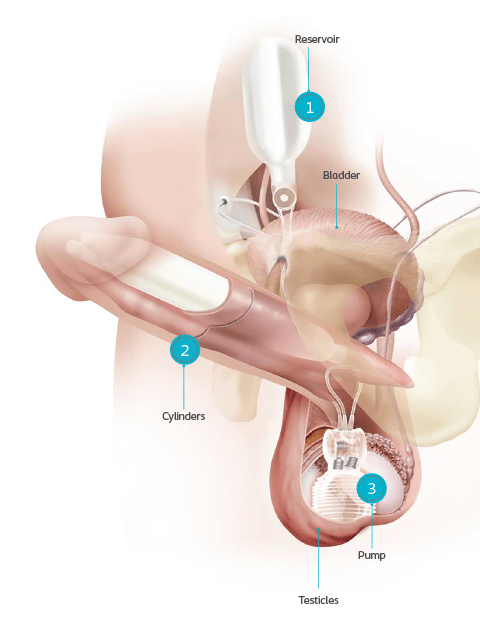
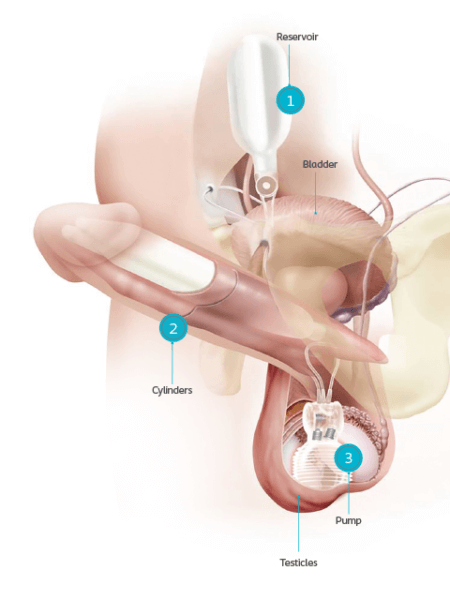
The most commonly used inflatable penile prosthesis is a three-piece system consisting of:
- Two inflatable cylinders placed inside the erection chambers of the penis
- A fluid reservoir placed internally
- A small pump placed inside the scrotum
All three components are concealed inside the body.
When an erection is desired, the patient squeezes the pump in the scrotum. Fluid moves from the reservoir into the cylinders, producing penile rigidity. The erection remains until the patient activates the release mechanism, allowing the fluid to return to the reservoir.
Unlike an erection produced by medication or sexual stimulation, an implant erection does not disappear automatically after orgasm. The patient decides when to inflate and deflate the device.
The Cleveland Clinic’s guide to penile implants provides an independent explanation of how inflatable penile prostheses function.
For a more detailed explanation of the device itself, see our guide to the three-piece inflatable penile implant.
Inflatable vs. Malleable Penile Implants
There are two major categories of penile prosthesis.
Inflatable Penile Implant
Inflatable implants use internal cylinders, a pump and fluid to create an erection when desired.
Three-piece inflatable implants are often preferred because they provide a more natural transition between the flaccid and erect states. The EAU notes that three-piece devices are generally preferred because they provide erections that more closely resemble natural erectile function.
Malleable Penile Implant
A malleable penile implant uses two flexible rods placed inside the penis.
The penis remains firm and can be manually positioned for intercourse or concealment. Malleable implants contain fewer mechanical components and may be easier to operate for men with limited hand dexterity, but they do not provide the same flaccid state as a three-piece inflatable device.
The appropriate implant depends on anatomy, medical history, manual dexterity, previous surgery and patient preference.
The Perito Minimally Invasive Infrapubic Technique
There are two principal surgical approaches to inflatable penile prosthesis placement: penoscrotal and infrapubic.
Dr. Paul Perito has spent decades refining the infrapubic approach; rather than placing the primary incision through the scrotum, the infrapubic technique places the incision above the base of the penis.
Dr. Perito first described his minimally invasive infrapubic technique in peer-reviewed medical literature in 2008. Subsequent research has evaluated the technique’s efficacy, patient satisfaction and complication profile.
A peer-reviewed study published in the International Journal of Impotence Research evaluated the minimally invasive infrapubic technique and reported high patient and partner satisfaction while describing an infrapubic skin incision of approximately 3 cm.
A separate historical review published in 2023 describes Dr. Perito as having performed thousands of infrapubic implantations and having taught hundreds of surgeons. It describes typical training sessions involving multiple implants performed through an approximately 2 cm infrapubic incision.
Patients interested specifically in this operative approach can read more about the minimally invasive infrapubic technique and the Perito Implant™.
Choosing a Penile Implant Surgeon
Penile implant surgery is highly specialized, and surgeon experience matters; published research has found associations between higher penile-prosthesis surgeon volume and lower rates of reoperation and postoperative infection.
Dr. Perito’s trademark infrapubic technique has been described in peer-reviewed medical literature, and an independent historical review of penile implant surgery credits him with performing thousands of infrapubic implant procedures and teaching hundreds of surgeons.
Patients considering surgery can review Perito Urology’s clinical abstracts and published data and learn more about Dr. Paul Perito’s background and experience.
Medical Sources and Further Reading
- European Association of Urology — Management of Erectile Dysfunction
- American Urological Association — Erectile Dysfunction Guideline
- Cleveland Clinic — Penile Implants: Purpose, Procedure, Risks & Recovery
- Antonini et al. — Minimally Invasive Infrapubic Inflatable Penile Prosthesis Implant for Erectile Dysfunction
- Wilson et al. — Celebrating 50 Years of Penile Implants
- Long-Term Survival Rates of Inflatable Penile Prostheses: Systematic Review and Meta-Analysis
- Association Between Surgeon Procedure Volume and Reoperation Rates for Penile Prosthesis Implantation
- A Nationwide Analysis of Postpenile Prosthesis Infection
- American Urological Association — Peyronie’s Disease Guideline
Medical review: Paul E. Perito, MD, FACS
Last reviewed: August 2026